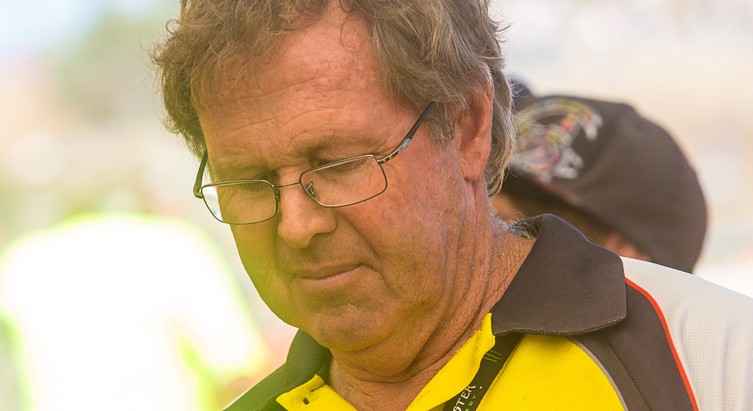
MX Nats: Team Manager Musings Part 4
We’re now sitting halfway through the 2014 Monster Energy MX Nationals series, and Round 6 at Swan Hill is fast-approaching. To fill in some down-time, MX Nationals Media spoke with Team Managers on a range of subjects, and will bring their responses to you in this four-part special feature over the next fortnight. In Part 4, we hear what they have to say about two-strokes being able to compete against four-strokes.
JF: Jay Foreman – Team Motul Suzuki
RT: Rob Twyerould – KTM Motocross Racing
CD: Craig Dack – CDR Yamaha
TC: Troy Carroll – National Pump Monster Energy Kawasaki
ML: Mike Landman – Penrite Oil Honda Racing
CA: Craig Anderson – Husqvarna Motocross Racing
What’s more important, the rider or the bike?
JF: It’s a balance of both really; a good rider needs a good bike. But I would say probably the rider.
CA: That is a tough one. If you’ve got the best bike and the worst rider you’re not going to win and vice versa. It’s a tough one and it’s got to be a mix, but if I was going to say in motocross it’s always been the rider a bit more than the bike.
RT: I think the rider has the biggest potential to influence the result but he also has to ride a good bike, so I would say it’s 70% the rider and 30% the bike.
ML: Good question! I think probably the rider. I think the rider can overcome situations. You could have a rider that struggles a bit on the best bike in the world and he still may not get the result you want. So I would say the rider.
CD: The rider. From my point of view, I’ve been with Yamaha for nearly 30 years and we have 100% confidence in the product that we’re using, so in our case it’s the rider that we need to make the difference.
Do you think that two-strokes and four-strokes should compete together in the same class?
JF: It depends on what class. I think the parity is not right with 250 two strokes, I think it could be right with 125 two strokes, but I don’t think the parity we have here is right, no.
CA: At the end of the day, I think some tracks suit the two strokes, and some tracks suit the four strokes. As we’ve seen at Appin, both the four strokes won the motos, and maybe at Wanneroo the two strokes might win. I think it’s a 50/50 mix with the tracks. It is hard to compete with more horsepower on a 250F so obviously those guys do need to work a bit harder.
RT: Definitely yeah. I think so.
ML: In the lites class, definitely not. Not a 250 two stroke anyway, maybe a 150 or something like that. A stock 250 four-stroke out of the box, is anywhere from 35, 36 to 38hp and a stock 250 two-stroke is 8-10 more horses than that. It is possible to get a 250 four-stroke to about 40 or 41hp but you can increase the power in the two stroke as well and it’s faster to begin with. They should be in separate classes.
CD: I haven’t really focused on the argument or the debate enough to really comment. We aren’t involved in the two-stroke program so I haven’t seen too much reason to get involved in it.
For CD: Do you think that that’s something you guys might get involved in, in the future?
CD: In the short term we don’t see any reason to, but you can never say never. I don’t know what the Japanese are thinking or what’s coming in the future, but for now our team is pretty solid on just staying with the 450.
Do you think riding the classes separately would cause issues with rider numbers?
ML: No, I don’t think so. I think that’s something that could be worked out. My concerns are with running the two together – one, is the big horsepower advantage, and two, I can see that the average person who goes to buy a bike is paying similar money for something that has 10 more hp, probably less in maintenance, and I can see it killing the 250 four stroke class because you can’t blame people. If you’re a privateer riding in that class it’s a no brainer, you will ride a 250 two stroke. I totally disagree with it because it’s not a fair and level playing field.
Do you think that Kayne Lamont is a chance to win the MX2 championship?
JF: For sure.
RT: Definitely.
Do you think he would be if he was on a four-stroke?
JF: I don’t know. I don’t think the two-stroke riders do themselves any favours in going further in the sport by riding a two-stroke. It would be a huge risk to put one on, not knowing how good they really are on a 250 four-stroke.
RT: I definitely do yeah. No difference.
CA: That one is hard to answer because he was riding a four-stroke for most of last year and his results don’t show what they show this year. Obviously it does look like the two-stroke is better but I think Kayne being healthy, and not hurt, that he’s showing a lot more speed this year than he did last year. I don’t think it would be too much different. I think the guys that are doing well on the two-strokes would do the same on a four-stroke. The same as if Luke Clout or any of the Serco boys rode two-strokes, I think they would be in the same positions.
Do you think that less are stepping up into the MX1 class because the two strokes are so accessible and affordable now?
JF: Yeah it’s so tricky. The two stroke is such a tricky thing right now, and I don’t know what the answers are. I just know that it’s not a level playing field right now. A couple of years ago it was, well it seemed like it was. I don’t know what has changed so much but I know the two strokes are getting better, and whether they have just leap-frogged so far ahead right now, I don’t know.
CA: I don’t think it’s just that, I think it’s just no one wants to ride 450’s because you have to be a lot stronger, a lot fitter, you have to work harder. That class is a lot faster than what it has been in the past, and I think people don’t want to step up because they’re not prepared to work. You know, you ride a 250F or 250 two-stroke, and sure they’re hard to ride, your heart rate is high, you’re getting tired but it’s nothing like riding a 450. When a 450 gets traction and gets away from you, you are in trouble. I’ve always been the sort of guy that wants to race in the biggest class, and I think that’s what a lot of the younger kids need to work out that when they’re stepping up that they can go all the way to the top, and then you got to work your butt off to stay there. If you step up earlier you have more time to get used to the bigger bike instead of riding a 250 for 6 and I think it lengthens your professional career too.
You might also like...
News
7 days ago
DEACON DENNO CROWNED SMX NEXT CHAMP
The Triumph Factory Racing rider concluded the five-round series with three podiums, including two wins.
A1
2 weeks ago
WIN A SHERCO 450SEF FACTORY OR KTM 300EXC!
Motorex are celebrating this year’s 100th FIM 6DAYS, and giving you the chance to win a brand new bike.
Beta
3 weeks ago
RUBEN CHADWICK CLAIMS AHEC OPENER
The Beta Motorcycles Australia rider delivered a standout performance on the Beta RR300 Race 2T.
News
3 weeks ago
Ruprecht Dominates Dungog AusEnduro
Brutal conditions shook up the field across Round 3 and 4 of the AusEnduro Championship in Dungog, NSW.
Beta
3 weeks ago
BETA’S PROTOTYPE RX250 4T MXER
Beta completes its line-up of MX models with the unveiling of a prototype 250cc four-stroke.
Cassons
1 month ago
WALSH MAKES FINKE RETURN WITH HONDA
Five-time champ David Walsh joins 2025 victor Corey Hammond and podium finisher Brodie Waters.
News
1 month ago
YAMAHA FLEX AT WONTHAGGI OPENER
Yamaha Australia’s motocross teams dominated Round 1 of ProMX, winning four classes and eight races.
KTM
1 month ago
SANDERS WINS RALLY-RAID PORTUGAL
Red Bull KTM Factory Racing’s Daniel Sanders lead from start to finish to win Round 2 of the W2RC.
Be the first to comment...