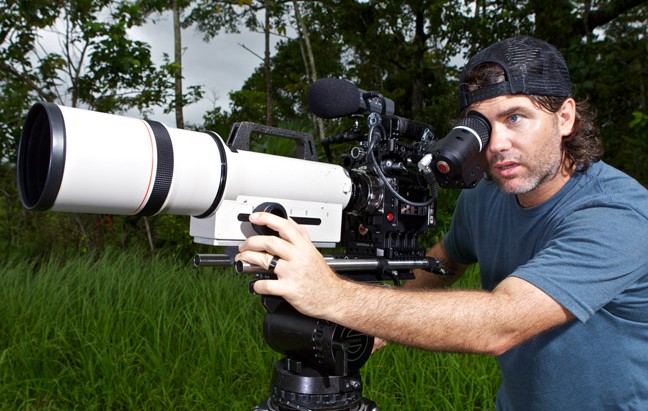
The guy who shot JDR’s Dream Ride slow-mo
Capturing some of the surfing industry’s most creative angles is a walk in the park for Delinquent Digital Cinema, Andrew ‘Shorty’ Buckley. Typically swanning around Indonesia and Hawaii wielding a 500mm lens, Shortly found himself amidst the tropical heat of North Queensland in November 2011, filming an industry first – JDR KTM’s Dream Ride. Seeing as though Delinquent Digital Cinema is based in the same Sydney premises as Transmoto, we caught up with Shorty to talk about popping his moto cherry.
Shorty shot JDR’s dream ride on the Phantom Flex – a 2000+FPS camera that will blow your mind
In terms of projects you’ve been a part of in the past, was JDR’s Dream Ride up there?
AS: Oh man, it was bloody amazing. I mean, I’ve worked on some big projects before, but if the sun’s out at the track you can basically nail your job on the spot. Surfing is a little different; you’re usually booked for two weeks – waiting for the right swell, tide and wind direction. The fact is, the whole thing was so well organised, we were totally looked after and the custom-built track was absolutely insane. Malcolm Stewart and Josh Cachia were throwing down some seriously gnarly shit. In essence, JDR was pretty ambitious with what they wanted to get out of it, considering none of them had worked with the equipment that was used. At the end of it all, we nailed the three-day timeframe and I worked my ring off with so much content to file at the end of the day. The results speak for themselves; total team effort.
On the topic of equipment, the shoot was essentially an industry first. Why was that?
In an off-road situation – as far as I’ve been able to tell – it’s first time, ever, that so much advanced equipment was in one place. Basically there was a brand new Red Epic, a brand new Phantom Flex, seven Zeiss primes – which are just amazing glass – and then we had a 300mm and a 150-500mm PL mount Canon lenses. And that doesn’t even include all the support gear that goes with it: the rails, rods, tri-pods, batteries, computers – the list was almost endless. I think there was a total of nine huge waterproof Pelican cases full of gear that was loaded onto a truck and driven from Sydney to Cairns. It would’ve easily cost in excess of $10,000 to fly it there.
Does filming with the Phantom Flex and Red Epic require a different scene set-up and frame setting approach?
Definitely. Because we were breaking new ground and I was the only person there familiar with using a Phantom Flex, it was a steep learning curve for everyone. The majority of the time I was shooting with the Flex at around 1600 frames per second at 2K resolution – current cinema quality. Unlike other cameras, you can’t just hit the record button when you see something insane going down. It’s a process of choosing what to capture, timing when to start the Flex’s engine and then transferring those recorded files from its ram to the hard drive manually – before resetting it all again. Over the three days the guys kind of joked that I only worked four seconds at a time! And to put it into perspective, four seconds of Flex footage at 1600fps rendered into real-time 25fps video, translates to roughly 10 minutes of footage. In total I reckon I recorded around two hours of raw Flex footage. The hard drives required to store the Flex’s footage alone, was unreal.
You might also like...

2026 SMX WORLD CHAMPIONSHIP VIDEO PASS
The SMX Video Pass is back, and again providing live and on-demand access to all 31 rounds.

2026 ENDURO & CC MODELS: 7-BRAND PRICE COMPARO
A handy table of easy-to-compare prices for seven brands’ 2026 enduro and cross-country models.

HONDA CLAIMS EIGHTH AUSX TITLE
Dean Wilson sealed the deal for Honda with a dominant 2025 Australian Supercross season.
National Motorcycle Insurance
5 months ago
Ride Smart | Presented by National Motorcycle Insurance
Transmoto’s Simon Barratt covers some handy tips on how to protect your dirt bike, presented by National Motorcycle Insurance.
KTM
6 months ago
KTM DOMINATES 2025 AUSTRALIAN ENDURO CHAMPIONSHIP
The KTM DM31 Racing Team wrapped up four titles at the weekend’s AusEnduro season finale.

Boost Secures 2025 AUSX Naming Rights
The Australian Supercross Championship is set to launch into its biggest season yet.

TT Circuit Assen To Host 2027 MXoN
The 80th edition of the MXoN will see the legendary event return to Dutch soil in 2027.

First Look: Aus MXGP Battleground
The 2025 MXGP of Australia track design has been revealed.
Be the first to comment...