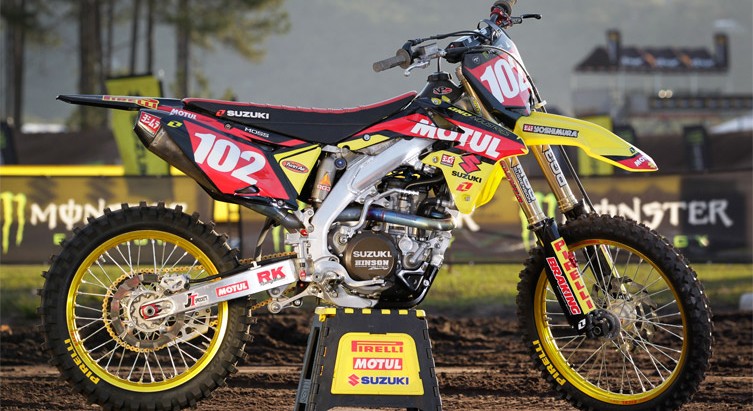
Bike Dissected: Matt Moss’ 2013 Suzuki RM-Z450
Matt Moss’s RM-Z450 is proof positive that a near-standard bike which is dialled to suit its rider can win a premier-class MX Nationals title. This article originally appeared inTransmoto Dirt Bike Magazine‘s 2013 November (#37) Issue.
When the RM-Z450 first arrived in 2005, the other race teams had all been campaigning high-performance four-strokes for years. So Suzuki thought they’d be playing catch-up with their all-new, four-speed, carb-fed thumper. But Team Suzuki made short work of it. In the hands of Daryl Hurley, Suzuki’s RM-Z450 won the premier-class (then the “Pro Open”) title that year. Season 2005, however, was the last time Suzuki would get their hands on the most coveted trophy in Australian Motocross … until now, that is.
Sure, they’d done well in the Lites/MX2 class. Teamed up with the hard-charging Matt Moss, the Motul Pirelli Suzuki team won the 2008 MX Nats title, and the MX and SX title double the following year. But when Moss signed a deal with KTM for 2011 – which subsequently took him to America for 18 months – it derailed Team Suzuki’s carefully laid plans for their favourite son to step up to the premier class and continue his title-winning form. In both 2011 and 2012, Suzuki’s Cody Cooper finished third in the MX1 title chase, while Todd Waters took the brand to within 11 points of the title last year. But in the class where winning mattered most, the No.1 plate continued to elude Suzuki. And it was weighing on the boys in yellow.
When Waters signed with KTM for 2013 and Moss returned from America, it was almost inevitable that Suzuki would re-hire the 25-year-old Moss; so he could pick up where he left off with the team. And that’s exactly what Mossy did. After an uncharacteristically cautious and calculated start to the 2013 MX Nats season, Matt Moss got his head, body and bike sorted by the series’ mid-point and came home like a stream train. Amid a heated rivalry with Waters, Moss claimed the red plate at Round 7 of the 10-round championship, and never let go of it. It was Mossy’s first premier-class title; a title win that vindicated Team Suzuki’s decision to focus on a two-rider assault in the MX1 class.
So, what would you expect to find under the plastic clothing of Mossy’s title-winning RM-Z450? A world of unaffordable aftermarket unobtainium? Well, no. This national title-winning machine is surprising close to standard; a fact that underlines just how good a race bike platform Suzuki’s ninth-generation RM-Z450 now is.
Mapping
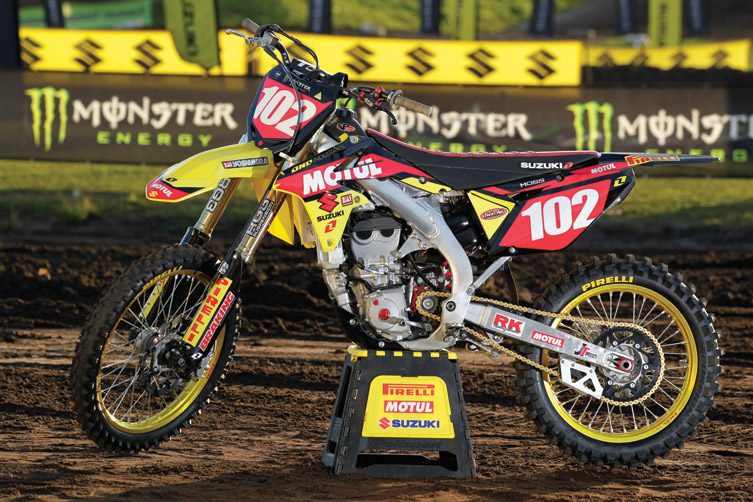
The team reckons the pre-programmed maps installed in the aftermarket Vortex X10 ECU has played a key role in harnessing the engine mods to produce a torquey, user-friendly power curve. There’s more grunt right through the rev range, but it remains smooth and tractable. The rev limiter has been raised slightly, made possible by the fact the team tears down the motor after each round. Unlike his teammate, Moss doesn’t run Vortex’s bar mounted dual-map switch. With superb throttle control, Moss likes his right hand to moderate the power. And he hasn’t changed the standard 13/50 final gearing all season.
Chassis
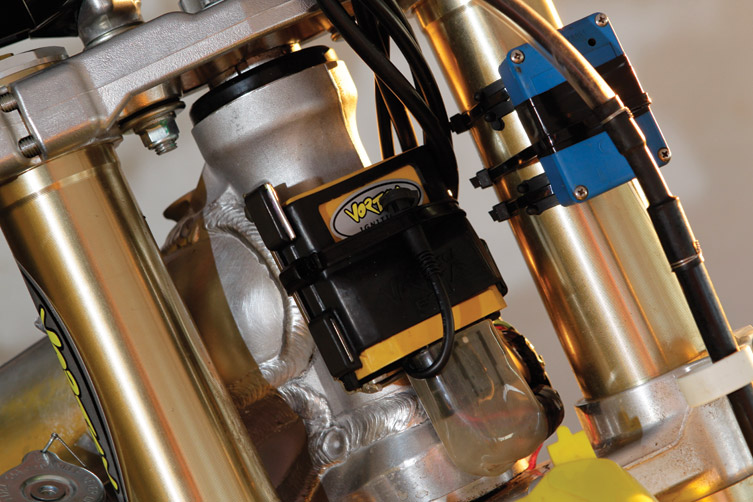
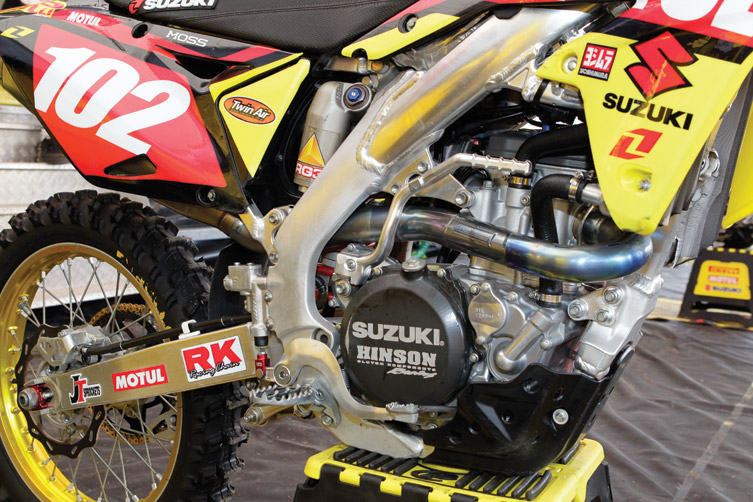
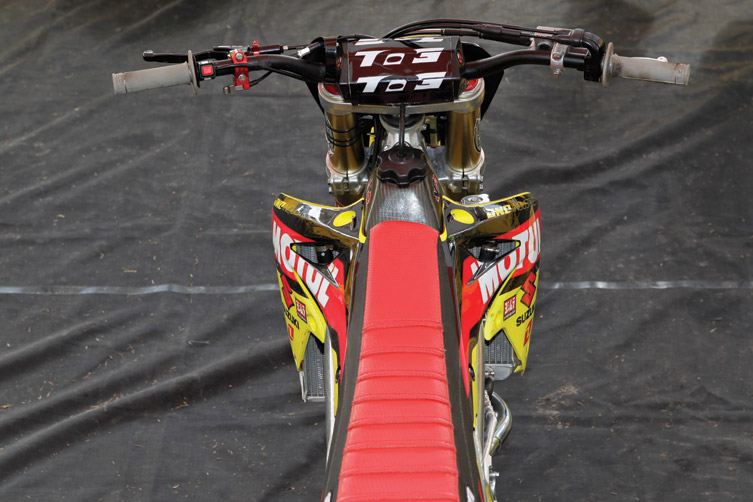
The bike’s twin-spar alloy perimeter frame is 100% standard. There’s no extra gusseting or modified mounts whatsoever. The subframe, swingarm and linkage are also dead stock. Even the triple clamps are production units. The team used to run RG3 clamps with a 20mm offset for supercross, but returned to the standard triple clamps (with 21.5mm offset) for the 2013 MX Nats. With the slightly more raked out front-end frame geometry of the 2013 RM-Z450, Moss found the standard clamps tend to work better at high speed and through long, deep ruts.
Engine
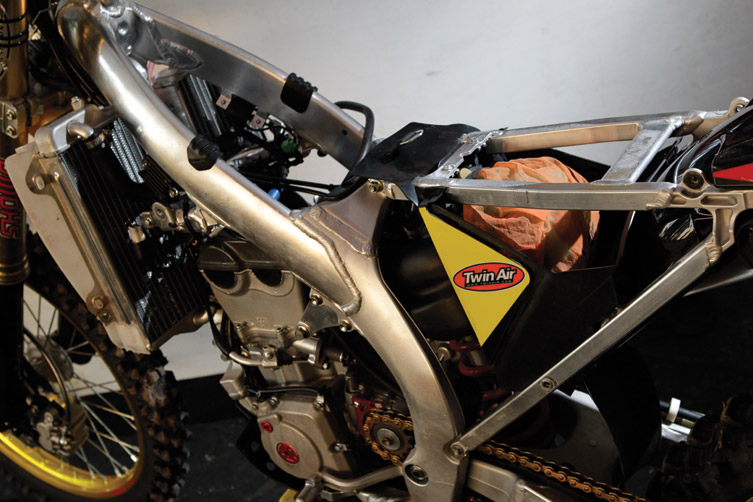
Aside from a Hinson clutch basket, inner hub and pressure plate (fitted to improve durability), the powerplant’s bottom-end is completely stock. The cylinder head is ported by PTR’s Phil Tainton, and uses a set of HotCams camshafts. Cylinder, piston, valves and valve seats are all standard-issue, though the compression ratio is increased via a thinner head gasket. A Yoshimura RS-4 Ti exhaust system, Vortex ECU and VP Roo100 fuel are all to optimise performance, while an RK chain and JT sprockets (in a standard 13/50 combo) get all that broad and torquey power to the rear wheel.
Wheels & Brakes
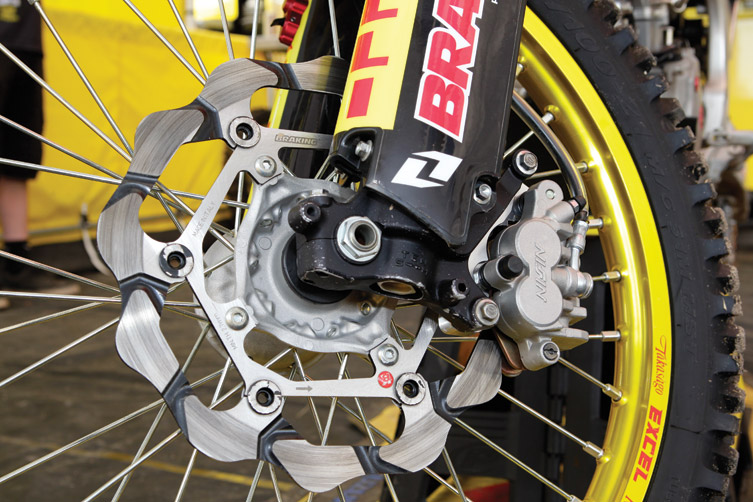
The bike runs standard hubs, which are laced to gold Excel rims. Mossy likes to use Pirelli Mid-Soft 32 tyres – front and rear – at most tracks, though he opts for the sand-specific Soft 410 rear on full-blown sand tracks. He also prefers a narrower 80/100-21 front on sand. Moss doesn’t like the feel of mousse tubes, so the team runs ultra heavy-duty Pirelli tubes in a double layer to minimise puncture risk. Braking brake discs are used at both ends – a 270mm Batfly disc on the front, and a Wave disc on the rear, whose caliper gets a Works Connection alloy guard.
Suspension
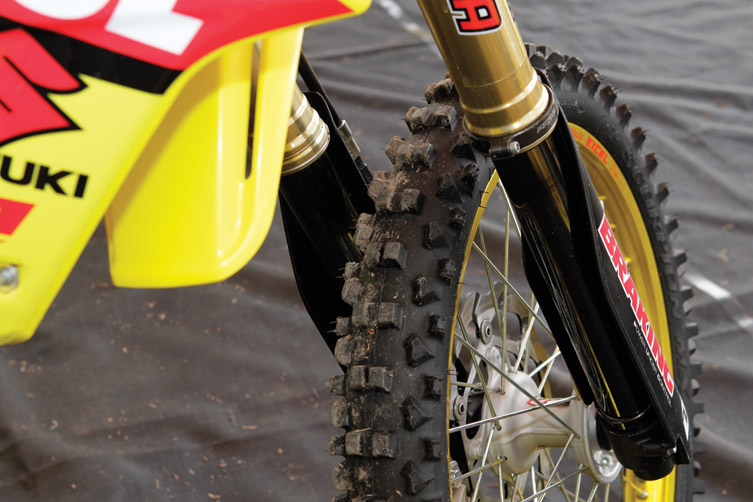
Moss uses Showa’s Type 2 SFF fork (that Suzuki’s 2013-model RM-Z450 first arrived with). The chrome sliders get a black DLC coating from RG3 for a plusher action, but all internal components remain standard. Mossy settled on the stock (1.0kg/mm) spring rate, but the compression damping is beefed up to help the fork ride higher in its stroke. Similarly, the shock absorber is standard, including spring rate; though its shaft also gets the DLC coating and valving mods, and the shim stack is mated with a different piston. An X-Trig preload collar is also fitted to make adjustment easier.
Bling Bits
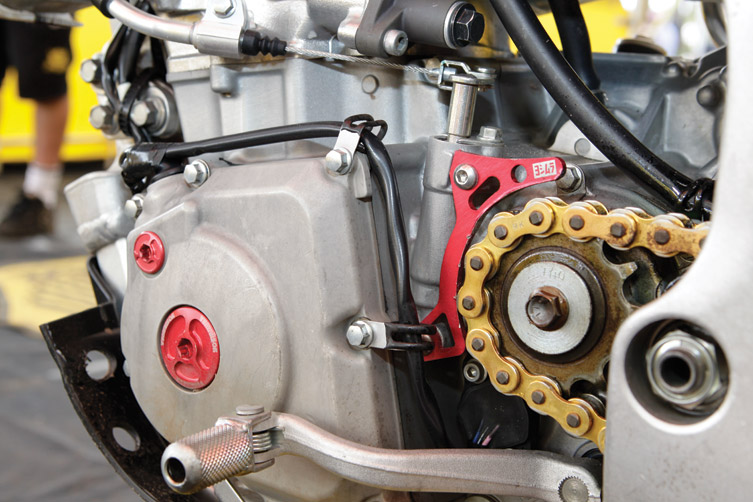
A fresh set of One Industries graphics is fitted for each race meet, and there’s a Yoshimura accessories kit: red alloy chain-adjuster blocks, rear brake clevis, engine plugs and a case saver. Interestingly, both rear brake pedal and gearshift remain standard. The team has tested aftermarket options, but can’t see any benefit over the standard parts, and they haven’t had one pedal failure all year. As alloy skidplates were found to bind up the frame’s flex characteristics too much, a hard plastic unit (from an RMX450Z) is used. And as precautionary measures, both muffler and footpegs are lockwired, while the radiator cap is secured by an R-clip.
Cockpit
Of all the 2013-model 450cc motocross bikes, the RM-Z comes with the most aggressive, race-oriented ‘work bench’. It has the flattest seat, which positions the rider right over the front of the bike and, as a result, Moss has done very little to reconfigure his Sunday office. He runs a set of Tag Metals bars in a Carmichael bend, a Pro Circuit quick-action alloy throttle tube, a Works Connection clutch perch to lighten the lever-pull and a One Industries pleated seat cover to give his arse more purchase on the machine. Both grips are soft half-waffle specimens, but Moss likes the waffle cut off on the left side. He holds them so tight, they still spin with lock-wire, so the team has to secure them with SuperGlue! They also fashion a plastic flange for the left grip (cut out of a front plate with a holesaw) to prevent Mossy’s hand slipping inwards and hitting the kill switch when he’s got arm pump. The fuel tank is a specially made carbon fibre unit from Italian company, CRM. At 6.7L, it adds 500ml of fuel capacity, which can be critical for 30-minute (plus two laps) motos on the MX Nats’ sand tracks.
Jay Foreman – Manager
“As a team, the key change we made a couple of seasons ago was deciding to concentrate 100 percent on the premier class, and hire two 450cc riders. It was crazy to think we could campaign both a 250 and 450 at this level, because it’s very expensive to develop two very different bikes and carry spares for both. A 250 is basically twice as expensive as a 450 – in terms of development and maintenance costs – to make it competitive. Plus with only one rider in each class, we weren’t getting the benefit of having riders bounce ideas off each other with bike development, or push each other around practice tracks. This two-rider strategy is what CDR Yamaha has done for years and their results prove it works. Our two best years in the MX1 class have come in 2012 and 2013 when we’ve focused solely on that class. As much as the MX2 title wins with Matt Moss were great, it’s the premier class that you really want to win. This year, Matt and Cody [Cooper] went 1-2 at a few of the rounds, and that’s been very rewarding for us as a team. It’s been a great achievement. If you want to grab a bike off a dealer floor and go racing, I believe that the production RM-Z450 is the best performing and most reliable bike on the market, and having that fantastic production bike as a platform has certainly made our job easier. When people look at our race bikes, they’re amazed how close to stock they actually are.”
Jess Foreman – Mechanic
“Matt runs a similarly aggressive engine to what we developed for Todd Waters last year. Matt’s throttle control and bike feel is so good, he can take advantage of that punchy engine spec, but we’ve also got awesome torque out of the engine to make sure it’s user-friendly. Matt Moss is the hardest rider I’ve ever known on his clutch, so he starts motos with heaps of lever freeplay. I remind him via a mid-moto pit board to adjust the freeplay again. At the season’s first three rounds, we were fighting to get the fork to hold up in its stroke and feel settled under brakes and through the mid-corner. When we used a firmer spring to do that, Matt didn’t like the feel of the front-end, so we developed a great valving spec instead, and he’s run that ever since. Matt and Cody use exactly the same shock settings, and Cody’s fork is a bit firmer only because he’s 10kg heavier. Even though the external adjuster on the SFF makes preload changes quick and easy, Matt doesn’t like to change fork preload at all. He really doesn’t like a bike with a too-firm feel in its springs, so he runs zero preload – whether we’re racing at the flat and sandy Hervey Bay or the undulating hardpack of Toowoomba. He doesn’t like anything that changes the core feel and feedback of the chassis, so clickers are all we use to fine-tune the valving spec. For tracks with big downhill braking bumps, we might drop the forks through the triple clamps a little. But that’s it.”
—
Want to view this article in magazine form? Grab yourself a print or digital edition of Transmoto Dirt Bike Magazine‘s 2013 November (#37) Issue. For an in-depth interview we shot with Mossy moments after he clinched his 2013 premier-class MX Nats title, click here.
1 Comment
You might also like...
A1
2 days ago
TECH BREAKDOWN: 3D BY EK CHAINS
3D by EK Chains’ tech forges stronger chains that run smoother and last longer.
Features
3 days ago
DAKAR DELIGHT: ’27 KTM 450 RALLY REPLICA
Derived from the Dakar-winning machine, the 2027 KTM 450 Rally Replica arrives in extremely limited numbers.
A1
5 days ago
PRODUCT SPOTLIGHT: THREE-D EK CHAINS
The all-new 3D 520MXR Series brings EK’s cold-forged 3D tech to off-road riders and performance motocross.
Ducati
2 weeks ago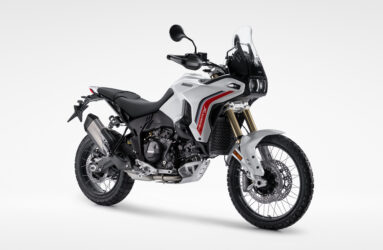
UP CLOSE: DUCATI’S 2026 DESERTX
What did an up-close-and-personal encounter with Ducati’s all-new, second-generation Desert X reveal?
Events
4 weeks ago
WHY YOU SHOULD RACE THE 8-HOUR AT NARRABRI…
The Transmoto 8-Hour at Narrabri oozes quiet-achiever rural appeal. Here’s six reasons you need to race it.
Features
1 month ago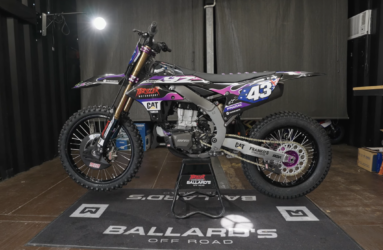
WATCH: JACK MILLER’S YZ450F DIRT TRACKER
This is Jack Miller’s Yamaha YZ450F like you’ve never seen it before.
Features
1 month ago
WATCH: Husqvarna Trek 2025 Film
The full-length feature film captures six days of high-country adventure in Victoria.
Ducati
2 months ago
2026 Ducati Xpeditions Takes On Flinders
The six-day, 1800km adventure will take on the South Australian outback for Multistrada and DesertX riders.
This article is really cool to have found! I now own this bike and race it in Supermoto.
Good to know how it was previously set up 🙂