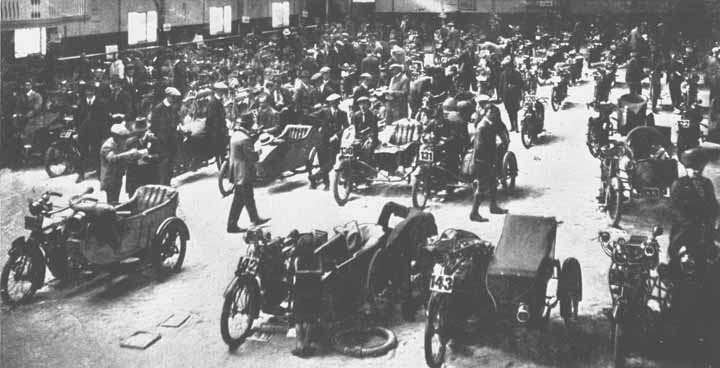
1913 Six Days Reliability Trial – the first one
Article from Federation Internationale de Motocyclisme
The FICM – Federation Internationale des Clubs Motocyclistes – was officially founded in December 1904. However, it went through some difficulties in the early days and it was necessary to wait until 1912 and a reformation of the FICM in November in London in order to have, this time, things really moving.
Following the suggestion of Mr J. Nisbett, Vice-President of the Auto-Cycle Union (ACU), the delegates agreed on promoting a international motorcycle event which would be held under the aegis of the FICM. The subject was a reliability trial (the word Endurance was used in French), based on the resistance of the machines manufactured at that time – quite far from what can exist today, as one may imagine – to the road conditions of those days. Asphalt was notably very rare. According to the report of the meeting held on December 1912 in Paris, following a suggestion of Mr Etienne Boileau (French, but working for the ACU), the ACU was in charge of organising this event and drafting the rules – what was already done: it was enough just to take existing rules and a trial event as these famous six days of reliability existed: these were the Six Days’ Reliability Trial held in Great Britain since 1903, year of the foundation of the British Federation, the Auto-Cycle Council – which would become the Auto-Cycle Union in November 1907.
On the programme of these Six Days of 1913, the words “with which is incorporated the First International Touring Trial” were added to the title of the event, as well as the following sentence just below: “under the classification rules of the Fédération Internationale des Clubs Motocyclistes and the open competition rules of the ACU”.
Here are a few extracts of what were the first sporting rules in the FIM history, which received some amendments during the meeting held on 25 October 1913 at the Automobile Club de France in Paris.
“A Motorbicycle is defined as a vehicle comprising a frame, two wheels and a suitable engine. Motor vehicles with more than two wheels, and weighing without oil, fuel and water, less than 300 kg, are included in the term Motorcycle. The divisions and classes into which motorcycles are divided by the FICM are as follows (cylinder capacity not exceeding – minimum weight without oil or fuel):
Division 1: 250cc – 40 kg; 350cc – 50 kg; 500cc – 60 kg; 750cc – 70 kg; 1000cc – 80 kg” (a minimum diameter for tyres is established for each class).
Division 2, Motorbicycles with sidecars: 350cc – 80 kg; 500cc – 100 kg; 750cc – 110 kg; 1000cc – 120 kg. All vehicles in division 2 must be fitted with a clutch or other “free engine” device
Division 3, Cyclecars: all three or four wheeled motor vehicles other than motorbicycles with sidecar, carrying one or two persons and of a maximum weight of 300 kg (without liquid): 750cc – 150 kg; 1100cc – 175 kg. All vehicles in division 3 must be fitted with a clutch or other “free engine” device, and with a change-speed gear.
The minimum weight for any driver or passenger carried by either a motorbicycle or any other class of motorcycle, is uniformly fixed at 60 kg. This weight may be made up, if necessary, by ballast”.
Concerning the equipment, “for all Speed Trials, motorbicycles must be equipped as follows: two brakes, working independently, one toolbag, efficient mudguards projecting beyond the tyre at least 10 mm each side, and embracing at least 120 degrees of the front wheel and 180 degrees of the circumference of the rear wheel, one saddle or seat, one stand, one efficient silencer – the use of a free exhaust is permitted in Speed Trials, and the exhaust gases must not be so directed as to raise the dust; uncovered exhaust ports in the cylinder walls are forbidden. In Reliability Trials, the motorbicycles engaged must be genuine touring machines, equipped accordingly. In addition to the equipment specified above they must also be furnished with: one carrier, weighing not less than 800 gr., and presenting a total supporting area of not less than 600 cm2; one or more fuel tanks with a minimum total capacity of 5 litres; one or more oil tanks of a minimum total capacity of one litre.”. For sidecars and cyclecars, the differences are: the saddle or seat for a passenger; the mudguard for rear wheel(s) must embrace at least 120 degrees of the circumference of the rear wheel.
The course must be published at least one month in advance, with details (hills, other difficulties), and also communicated to the participants; the controls must be indicated by banners stretched over the road. The dates – known for a long time – were from 19 to 23 August 1913, and the venue was the Lake District near Carlisle (in the north of England).
The participation of foreign teams was obviously necessary in order to respect the international character as well as the credibility of the FICM itself – which was much more difficult than it is today. The rules stipulated different colours for each participating country and the eleven FICM member countries – including the United States and Canada – were listed. In fact, only one team travelled to take part in this first FICM trial, France. The programme of these first Six Days mentioned the following entries:
– France: team participating with the colour blue. Entrant: Union Motocycliste de France.
– Mr Guilloreau on a Clement-Gladiator 350cc, twin-cylinder, 2.75 HP
– Mr Gabriel on a Clement-Gladiator 498cc, twin-cylinder, 4 HP
– MM. Bourbeau and Devaux on a Bedelia Cyclecar, 1100cc, twin-cylinder, 8 HP
– Great Britain: team participating with the colour green. Entrant: Auto-Cycle Union.
– W.B. Gibb on a Douglas 350cc, twin-cylinder, 2.75 HP
– W.B. Little on a Premier 499cc, single cylinder, 3.5 HP
– C.R. Collier on a Matchless with sidecar, 964cc, twin-cylinder, 8 HP
The French team members quickly retired from the competition. The British team received the permanent silver Trophy offered by the British Cycle & Motor Cycle Manufacturers & Traders Union Ltd. W.B. Gibb and Charles Collier also earned a gold medal.
Many people considered the course as very difficult, even prejudicial to the interest of the manufacturers entered, as the exaggerated difficulties of the chosen terrain had a negative influence on the performances. With vehicles of that time, weighing up to 300 kg, a mountain course with a barely designed lane must have been difficult. The press qualified the first day’s course as very difficult, but a child’s play compared to that of the second day…
There were 162 entries (one non-starter) – all British competitors racing in this well-known trial except for the Frenchmen. 51 got a gold medal, 21 a silver one and 27 a bronze one; 62 retired. The following events, as from 1920, strictly run as international FICM event, would have a lot less participants and a low number of national teams for some years…
By Marc Pétrier
Captions:
1:
Charles Collier (left) was the founder of the Matchless factory with his brother Harry. He was a member of the British team who took part in the 1913 Six Days driving a 964cc twin-cylinder Matchless with sidecar.
2:
The first ISDT Trophy, made of solid silver, 35 inches high and weighing 18 kilos, was presented as a permanent Trophy for the competition amongst the constituent members of the FICM by the British Cycle & Motor Cycle Manufacturers & Traders’ Union Limited. This Trophy disappeared in 1939 at the end of the Six Days held in Salzburg.
3:
Carlisle and the Lake District in the north of England welcomed the first International Six Days Reliability Trial, held in August 1913. It was the first official FICM event in the history, but it was the 11th Six Days’ Reliability Trial held in Great Britain. The first one took place in 1903 – year of the foundation of the British Federation.
4:
The official programme of the 1913 Six Days’ Reliability Trial included the general conditions of the event, the preliminary and the final regulations – called today the supplementary regulations.
5:
Beside the individual entries – all British riders – , two teams were taking part in the international part of the event, France and Great Britain, with three members in each team (driving two motorcycles and one sidecar or cyclecar).
Photos: FIM Archives/Coll. C. Lavery
You might also like...
News
3 weeks ago
2026 SMX PLAYOFFS: HUNTER’S TO LOSE?
Australia’s Hunter Lawrence heads into the 2026 SMX World Championship Playoffs as the top seed.
News
4 weeks ago
RUPRECHT SECURES PRO ENDURO CROWN
Wil Ruprecht wraps up the 2026 AusEnduro Pro Enduro and E2 titles at Coonalpyn.
News
4 weeks ago
AUSENDURO FINALE … THE MATH!
Wil Ruprecht heads to the 2026 AusEnduro finale at Coonalpyn 19 points clear of Korey McMahon.
News
4 weeks ago
Jett Lawrence to miss SMX Playoffs
Jett Lawrence will miss all three rounds of the 2026 SuperMotocross Playoffs.
AUSENDURO HEADS TO KEMPSEY
The Yamaha Australian Enduro Championship heads to Kempsey this weekend for Round 9 and 10.
News
2 months ago
WSX 2026: CALGARY OPENER PREVIEW
WSX kicks off in Canada, with the series also set for a first-ever visit to New Zealand later this year.
News
2 months ago
PROMX: FOUR TITLES ON THE LINE AT QMP
The 2026 Penrite ProMX Championship wraps up at Queensland Moto Park this weekend.
News
3 months ago
2027 DAKAR RALLY ROUTE RELEASED
The 2027 Dakar Rally route has been revealed, with a record 5,320km of special stages across Saudi Arabia.
Be the first to comment...